


- Afhalen na 1 uur in een winkel met voorraad
- Gratis thuislevering in België vanaf € 30
- Ruim aanbod met 7 miljoen producten
- Afhalen na 1 uur in een winkel met voorraad
- Gratis thuislevering in België vanaf € 30
- Ruim aanbod met 7 miljoen producten





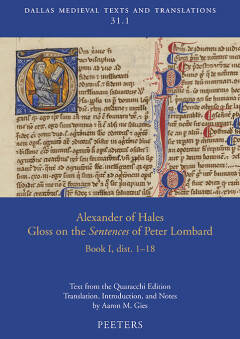
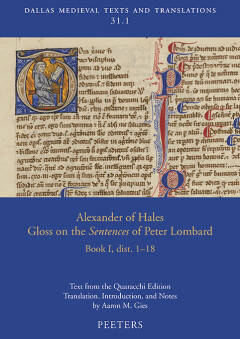
Alexander of Hales, Gloss on the 'Sentences' of Peter Lombard. Book I, Dist. 1-18
Aaron M Gies
€ 93,00
+ 186 punten
Omschrijving
In the years 1222-1227, before joining the order and becoming the first Franciscan to hold a chair as a master ruling in theology at the University of Paris, the English theologian Alexander of Hales (d. 1245) introduced the tradition of lecturing on the Sentences of Peter Lombard, producing one of the earliest and most influential commentaries on that book. After its prominence in the middle of the thirteenth century-its influence can be discerned in the group-authored Summa Halensis, in Bonaventure, Thomas Aquinas, and many others-the commentary languished unnoticed and nearly forgotten until 1945, when Francois-Marie Henquinet, O.F.M., discovered a thirteenth-century copy at Assisi. The rediscovered text was critically edited at Quaracchi between 1951 and 1957, but has remained unavailable in English until now. The first eighteen distinctions of Book One of Alexander's Gloss on the Sentences of Peter Lombard are presented here, together with an introduction and notes. They present Alexander's doctrine of divine unity and Trinity in its clearest and most systematic form, touching on important controversial questions of the time, such as the relationship of the soul with its powers and the existence or non-existence of a created habit of charity in addition to the uncreated charity that is the Holy Spirit. Along with the translation, the volume includes the Latin text of the modern critical edition.
Specificaties
Betrokkenen
- Auteur(s):
- Uitgeverij:
Inhoud
- Aantal bladzijden:
- 352
- Taal:
- Engels
- Reeks:
Eigenschappen
- Productcode (EAN):
- 9789042953635
- Verschijningsdatum:
- 31/12/2025
- Uitvoering:
- Paperback
- Formaat:
- Trade paperback (VS)
- Afmetingen:
- 17 cm x 24 cm
- Gewicht:
- 521 g


Alleen bij Standaard Boekhandel
+ 186 punten op je klantenkaart van Standaard Boekhandel
Cadeau

AANGERADEN


Beoordelingen
We publiceren alleen reviews die voldoen aan de voorwaarden voor reviews. Bekijk onze voorwaarden voor reviews.