


- Afhalen na 1 uur in een winkel met voorraad
- Gratis thuislevering in België vanaf € 30
- Ruim aanbod met 7 miljoen producten
- Afhalen na 1 uur in een winkel met voorraad
- Gratis thuislevering in België vanaf € 30
- Ruim aanbod met 7 miljoen producten





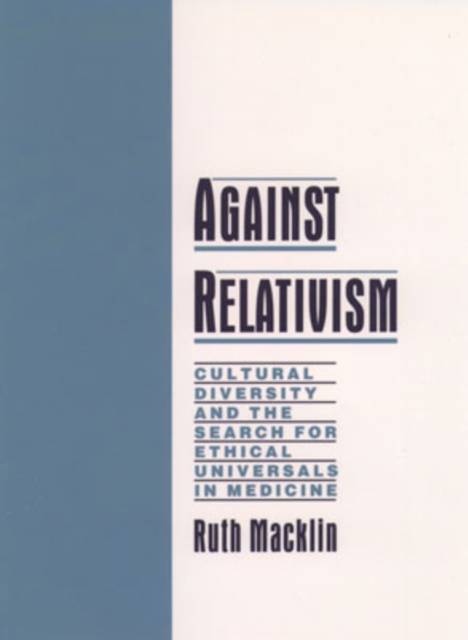
Against Relativism
Cultural Diversity and the Search for Ethical Universals in Medicine
Ruth Macklin
Hardcover | Engels
€ 141,95
+ 283 punten
Omschrijving
This book analyzes the debate surrounding cultural diversity and its implications for ethics. If ethics are relative to particular cultures or societies, then it is not possible to hold that there are any fundamental human rights. The author examines the role of cultural tradition, often used as a defense against critical ethical judgments, and explores key issues in health and medicine in the context of cultural diversity: the physician-patient relationship, disclosing a diagnosis of a fatal illness, informed consent, brain death and organ transplantation, rituals surrounding birth and death, female genital mutilation, sex selection of offspring, fertility regulation, and biomedical research involving human subjects. Among the conclusions the author reaches are that ethical universals exist but must not be confused with ethical absolutes. The existence of ethical universals is compatible with a variety of culturally relative interpretations, and some rights related to medicine and health care should be considered human rights. Illustrative examples are drawn from the author's experiences serving on international ethical review committees and her travels to countries in Africa, Asia, and Latin America, where she conducted educational workshops and carried out her own research.
Specificaties
Betrokkenen
- Auteur(s):
- Uitgeverij:
Inhoud
- Aantal bladzijden:
- 304
- Taal:
- Engels
Eigenschappen
- Productcode (EAN):
- 9780195116328
- Verschijningsdatum:
- 4/03/1999
- Uitvoering:
- Hardcover
- Formaat:
- Genaaid
- Afmetingen:
- 147 mm x 215 mm
- Gewicht:
- 489 g


Alleen bij Standaard Boekhandel
+ 283 punten op je klantenkaart van Standaard Boekhandel
Cadeau

AANGERADEN


Beoordelingen
We publiceren alleen reviews die voldoen aan de voorwaarden voor reviews. Bekijk onze voorwaarden voor reviews.