


- Afhalen na 1 uur in een winkel met voorraad
- Gratis thuislevering in België vanaf € 30
- Ruim aanbod met 7 miljoen producten
- Afhalen na 1 uur in een winkel met voorraad
- Gratis thuislevering in België vanaf € 30
- Ruim aanbod met 7 miljoen producten





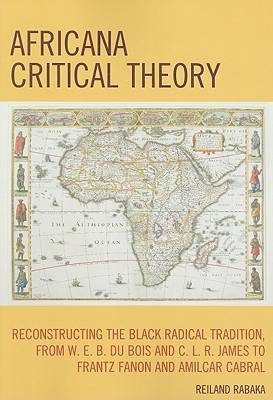
Africana Critical Theory
Reconstructing The Black Radical Tradition, From W. E. B. Du Bois and C. L. R. James to Frantz Fanon and Amilcar Cabral
Reiland Rabaka
Paperback | Engels
€ 135,95
+ 271 punten
Uitvoering
Omschrijving
Building on and going far beyond W.E.B. Du Bois and the Problems of the Twenty-First Century and Du Bois's Dialectics, Reiland Rabaka's Africana Critical Theory innovatively identifies and analyzes continental and diasporan African contributions to classical and contemporary critical theory. This book represents a climatic critical theoretical clincher that cogently demonstrates how Du Bois's rarely discussed dialectical thought, interdisciplinarity, intellectual history-making radical political activism, and world-historical multiple liberation movement leadership helped to inaugurate a distinct Africana tradition of critical theory. With chapters on W.E.B. Du Bois, C.L.R. James, Negritude (Aime Cesaire and Leopold Senghor), Frantz Fanon and Amilcar Cabral, Africana Critical Theory endeavors to accessibly offer contemporary critical theorists an intellectual archaeology of the Africana tradition of critical theory and a much-needed dialectical deconstruction and reconstruction of black radical politics. These six seminal figures' collective thought and texts clearly cuts across several disciplines and, therefore, closes the chasm between Africana Studies and critical theory, constantly demanding that intellectuals not simply think deep thoughts, develop new theories, and theoretically support radical politics, but be and constantly become political activists, social organizers and cultural workers - that is, folk the Italian critical theorist Antonio Gramsci referred to as "organic intellectuals." In this sense, then, the series of studies gathered in Africana Critical Theory contribute not only to African Studies, African American Studies, Caribbean Studies, Cultural Studies, Gender Studies, and Postcolonial Studies, but also to contemporary critical theoretical discourse across an amazingly wide-range of "traditional" disciplines, and radical political activism outside of (and, in many instances, absolutely against) Europe's ivory towers and the absurdities of the American acade
Specificaties
Betrokkenen
- Auteur(s):
- Uitgeverij:
Inhoud
- Aantal bladzijden:
- 452
- Taal:
- Engels
Eigenschappen
- Productcode (EAN):
- 9780739128862
- Verschijningsdatum:
- 1/07/2010
- Uitvoering:
- Paperback
- Formaat:
- Trade paperback (VS)
- Afmetingen:
- 175 mm x 251 mm
- Gewicht:
- 748 g


Alleen bij Standaard Boekhandel
+ 271 punten op je klantenkaart van Standaard Boekhandel

Beoordelingen
We publiceren alleen reviews die voldoen aan de voorwaarden voor reviews. Bekijk onze voorwaarden voor reviews.