



Je cadeautjes zeker op tijd in huis hebben voor de feestdagen? Kom langs in onze winkels en vind het perfecte geschenk!
- Afhalen na 1 uur in een winkel met voorraad
- Gratis thuislevering in België vanaf € 30
- Ruim aanbod met 7 miljoen producten
Je cadeautjes zeker op tijd in huis hebben voor de feestdagen? Kom langs in onze winkels en vind het perfecte geschenk!
- Afhalen na 1 uur in een winkel met voorraad
- Gratis thuislevering in België vanaf € 30
- Ruim aanbod met 7 miljoen producten





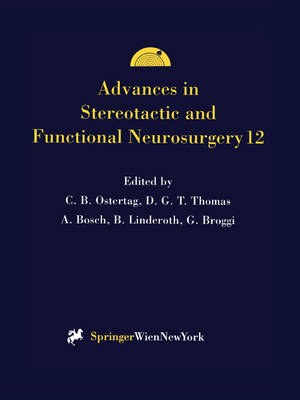
Advances in Stereotactic and Functional Neurosurgery 12. Vol.12
Proceedings of the 12th Meeting of the European Society for Stereotactic and Functional Neurosurgery, Milan, 1996
Hardcover | Engels | Acta Neurochirurgica Supplement | Advances in Stereotactic and Functional Neurosurgery | nr. 68
€ 190,45
+ 380 punten
Omschrijving
Neurosurgery o/the Future: Computers and Robots in Clinical Neurosurgical Practice and in Training - a Philosophical Journey into the Future Many present day neurosurgeons believe that they already obtain good results in operative surgery with the benefit of the operating microscope and other aids which have become available in the last three decades and that the introduction of computers and robots to the operating theatre is superfluous. However, it is clear from analogy with the function of the airline pilot, another profession where there are great demands on manual skill and on spatial awareness, that these devices do have much to offer neurosurgery. Classical neurosurgery, in the time of Cushing, Dandy and Scarff, was based on a three dimensional picture of the patient's brain formed in the surgeon's mind and often illustrated in elegant drawings. Such pictures were based on neuroradiological studies by pneumoencephalography, ventriculography or by angiography. Generally these stud ies showed the presence and position of a lesion by displacement of normal brain structures and the picture was built up by interference. This was then converted by the experienced neurosurgeon into a plan for the craniotomy site and the trajectory of the surgical approach. Once the brain was exposed further pre-operative information was obtained by visual inspection and by palpation with the brain needle. These classical forms ofneuroradiology have largely been superseded by computerised tomography and by magnetic resonance imaging.
Specificaties
Betrokkenen
- Uitgeverij:
Inhoud
- Aantal bladzijden:
- 144
- Taal:
- Engels
- Reeks:
- Reeksnummer:
- nr. 68
Eigenschappen
- Productcode (EAN):
- 9783211829783
- Verschijningsdatum:
- 23/06/1997
- Uitvoering:
- Hardcover
- Afmetingen:
- 210 mm x 279 mm
- Gewicht:
- 712 g

Alleen bij Standaard Boekhandel
+ 380 punten op je klantenkaart van Standaard Boekhandel
CADEAU


Beoordelingen
We publiceren alleen reviews die voldoen aan de voorwaarden voor reviews. Bekijk onze voorwaarden voor reviews.