


- Afhalen na 1 uur in een winkel met voorraad
- Gratis thuislevering in België vanaf € 30
- Ruim aanbod met 7 miljoen producten
- Afhalen na 1 uur in een winkel met voorraad
- Gratis thuislevering in België vanaf € 30
- Ruim aanbod met 7 miljoen producten





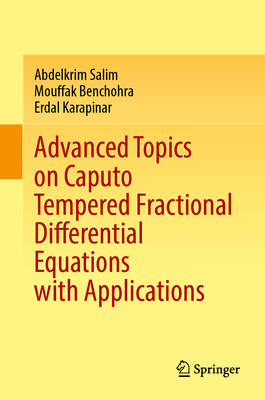
Advanced Topics on Caputo Tempered Fractional Differential Equations with Applications
Abdelkrim Salim, Mouffak Benchohra, Erdal Karapinar
Hardcover | Engels
€ 86,95
+ 173 punten
Omschrijving
This book offers a unified and rigorous treatment of nonlinear differential equations involving the Caputo tempered fractional derivative and its generalizations. Spanning nine chapters, the authors systematically develop analytical methods for solving a wide variety of problems, including those with nonlocal, impulsive, periodic and delayed structures, within both deterministic and random settings. Each chapter is dedicated to a particular class of problems, beginning with global convergence and uniqueness analysis for the successive approximations method and extending to systems with neutral and infinite delays, boundary value problems with impulses, and coupled systems. The analytical approaches employed throughout the book include a rich array of mathematical tools: fixed point theory (Banach, Schauder, Darbo, Monch, Schaefer, Sadovskii, and Krasnoselskii); coincidence degree theory; the method of upper and lower solutions; diagonalization techniques; and the measure of noncompactness. Special attention is given to various notions of stability, including Ulam-Hyers and Mittag-Leffler-Ulam-Hyers stability, as well as the existence of periodic and weak solutions. To ensure practical relevance and illustrate the applicability of each theoretical result, every chapter concludes with a section devoted to remarks and bibliographical suggestions as well as examples that highlight the effectiveness of the proposed methods. This book is ideal for graduate students, researchers, and professionals working in the fields of applied mathematics, differential equations, and fractional calculus.
Specificaties
Betrokkenen
- Auteur(s):
- Uitgeverij:
Inhoud
- Aantal bladzijden:
- 371
- Taal:
- Engels
Eigenschappen
- Productcode (EAN):
- 9783032233271
- Verschijningsdatum:
- 17/07/2026
- Uitvoering:
- Hardcover
- Formaat:
- Genaaid
- Afmetingen:
- 210 mm x 279 mm


Alleen bij Standaard Boekhandel
+ 173 punten op je klantenkaart van Standaard Boekhandel
Cadeau

AANGERADEN


Beoordelingen
We publiceren alleen reviews die voldoen aan de voorwaarden voor reviews. Bekijk onze voorwaarden voor reviews.