


- Afhalen na 1 uur in een winkel met voorraad
- Gratis thuislevering in België vanaf € 30
- Ruim aanbod met 7 miljoen producten
- Afhalen na 1 uur in een winkel met voorraad
- Gratis thuislevering in België vanaf € 30
- Ruim aanbod met 7 miljoen producten





€ 164,95
+ 329 punten
Uitvoering
Eenvoudig bestellen
Veilig betalen


Gratis thuislevering vanaf € 30 (via bpost)
Gratis levering in je Standaard Boekhandel
Omschrijving
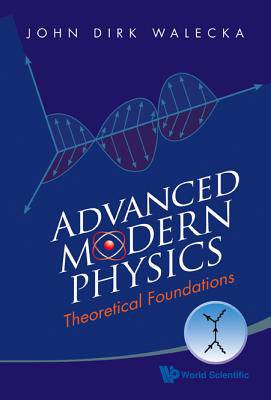
Our understanding of the physical world was revolutionized in the twentieth century -- the era of "modern physics". This book, aimed at the very best students, extends the coverage of the theoretical groundwork of today's physics presented in the previous volume: Introduction to Modern Physics: Theoretical Foundations (Vol. I). Typically, students have to wade through several courses to see many of these topics. The goal is to give them some idea of where they are going, and how things fit together, as they go along.The present book focuses on the following topics: reformulation of quantum mechanics, angular momentum, scattering theory, lagrangian field theory, symmetries, Feynman rules, quantum electrodynamics, including higher-order contributions, path integrals, and canonical transformations for quantum systems. Many problems are included that enhance and extend the coverage. The book assumes a mastery of the material in Vol. I, and the continued development of mathematical skills, including multivariable calculus and linear algebra. Several appendices provide important details, and any additional required mathematics. The reader should then find the text, together with the appendices and problems, to be self-contained. The aim is to cover the framework of modern theoretical physics in sufficient depth that things "make sense" to students, and, when finished, the reader should have an elementary working knowledge in the principal areas of theoretical physics of the twentieth century.
Specificaties
Betrokkenen
- Auteur(s):
- Uitgeverij:
Inhoud
- Aantal bladzijden:
- 500
- Taal:
- Engels
Eigenschappen
- Productcode (EAN):
- 9789814291514
- Verschijningsdatum:
- 2/04/2010
- Uitvoering:
- Hardcover
- Formaat:
- Genaaid
- Afmetingen:
- 162 mm x 234 mm
- Gewicht:
- 848 g


Alleen bij Standaard Boekhandel
+ 329 punten op je klantenkaart van Standaard Boekhandel
CADEAU

AANGERADEN


Beoordelingen
We publiceren alleen reviews die voldoen aan de voorwaarden voor reviews. Bekijk onze voorwaarden voor reviews.