


- Afhalen na 1 uur in een winkel met voorraad
- Gratis thuislevering in België vanaf € 30
- Ruim aanbod met 7 miljoen producten
- Afhalen na 1 uur in een winkel met voorraad
- Gratis thuislevering in België vanaf € 30
- Ruim aanbod met 7 miljoen producten





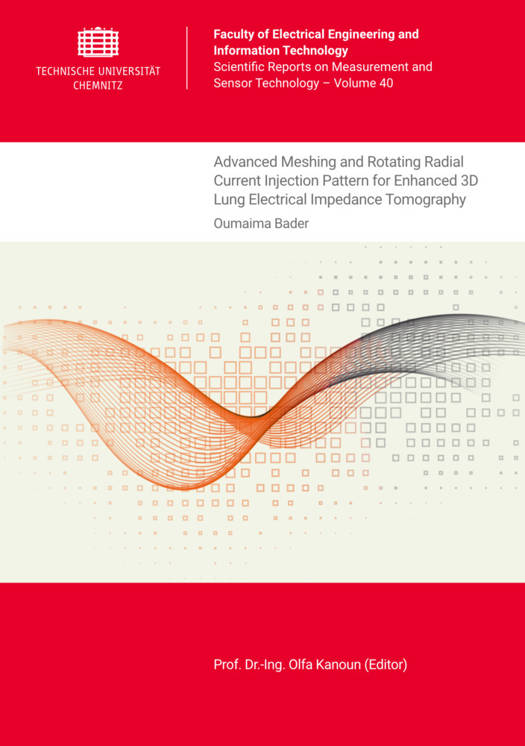
Advanced Meshing and Rotating Radial Current Injection Pattern for Enhanced 3D Lung Electrical Impedance Tomography
Oumaima Bader
€ 24,95
+ 49 punten
Omschrijving
Electrical Impedance Tomography (EIT) is a non-invasive, radiation-free imaging technique that enables continuous bedside monitoring of lung function through surface electrode measurements. Despite its suitability for real-time observation of respiratory dynamics, EIT is limited by low spatial resolution, uneven sensitivity distribution, and simplified 2D reconstruction models that inadequately represent 3D current propagation in thoracic tissues. This dissertation advances EIT toward volumetric lung imaging by combining anatomically refined 3D modeling with highly sensitive current injection pattern. Two biomimetic 3D finite-element thoracic mesh models are developed and validated. The first incorporates anatomically distinct tissues, including skin, fat, muscle, lungs, and pathological anomalies, enabling analysis of sensitivity and detectability. The second mesh is optimized for forward modeling and image reconstruction, ensuring numerical stability. A novel Rotating Radial (RR) current injection pattern is introduced to enhance current penetration depth and sensitivity to lung anomalies. Using 16-electrodes, eight electrode pairs are injecting per step, strategically placed according to thoracic anatomy, the RR pattern enhances current penetration within the thorax. Simulation and phantom experiments demonstrate superior performance compared to common patterns, achieving higher sensitivity, signal-to-noise ratios, and localization of lung nodules down to 3 cm in diameter.
Specificaties
Betrokkenen
- Auteur(s):
- Uitgeverij:
Inhoud
- Taal:
- Engels
- Reeks:
- Reeksnummer:
- nr. 40
Eigenschappen
- Productcode (EAN):
- 9783961003068
- Uitvoering:
- Paperback
- Afmetingen:
- 148 mm x 11 mm
- Gewicht:
- 359 g


Alleen bij Standaard Boekhandel
+ 49 punten op je klantenkaart van Standaard Boekhandel
Cadeau

AANGERADEN


Beoordelingen
We publiceren alleen reviews die voldoen aan de voorwaarden voor reviews. Bekijk onze voorwaarden voor reviews.