



- Afhalen na 1 uur in een winkel met voorraad
- In januari gratis thuislevering in België
- Ruim aanbod met 7 miljoen producten
- Afhalen na 1 uur in een winkel met voorraad
- In januari gratis thuislevering in België
- Ruim aanbod met 7 miljoen producten





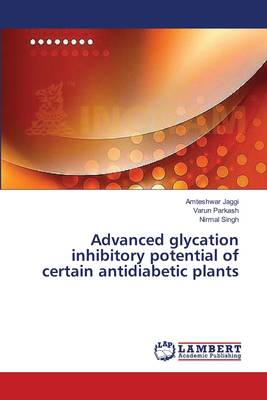
Advanced glycation inhibitory potential of certain antidiabetic plants
Amteshwar Jaggi, Varun Parkash, Nirmal Singh
Paperback | Engels
€ 47,95
+ 95 punten
Omschrijving
The present study was designed to investigate the antiglycation potential of hydro-alcoholic and alkaloidal fractions of selected plants. Seeds of Trigonella foenum-graecum, bulbs of Allium sativum, fruits of Momordica charantia. and leaves of Gymnema sylvestre were selected. The protein glycation inhibitory activity of these plants was evaluated using glucose-bovine serum albumin assay. Among the hydroalcoholic extracts, Trigonella-foenum graecum showed highest antiglycation activity (IC50 = 53.53 ± 1.24 µg/ml) followed by Allium sativum (IC50 = 68.36 ± 1.56 µg/ml), Momordica charantia (IC50 = 85.16 ± 1.87 µg/ml) and Gymnema sylvestre (IC50 = 103.66 ± 2.09 µg/ml). Among the alkaloidal fractions, the highest antiglycation activity was shown by Trigonella-foenum graecum (IC50 = 31.56 ± 1.36 µg/ml) followed by Allium sativum (IC50 = 40.46 ± 1.59 µg/ml), Momordica charantia (IC50 = 54.8 ± 2.12 µg/ml) and Gymnema sylvestre (IC50 = 64.50 ± 1.73 µg/ml). Aminoguanidine, a standard drug, showed 100% inhibition (IC50 = 22.45 ± 1.89 µg/ml). Alkaloidal extracts of these plants possess antiglycation activity and may be explored in diabetic complications
Specificaties
Betrokkenen
- Auteur(s):
- Uitgeverij:
Inhoud
- Aantal bladzijden:
- 64
- Taal:
- Engels
Eigenschappen
- Productcode (EAN):
- 9783659566332
- Verschijningsdatum:
- 9/07/2014
- Uitvoering:
- Paperback
- Afmetingen:
- 150 mm x 220 mm
- Gewicht:
- 102 g


Alleen bij Standaard Boekhandel
+ 95 punten op je klantenkaart van Standaard Boekhandel
Cadeau

AANGERADEN


Beoordelingen
We publiceren alleen reviews die voldoen aan de voorwaarden voor reviews. Bekijk onze voorwaarden voor reviews.