



Je cadeautjes zeker op tijd in huis hebben voor de feestdagen? Kom langs in onze winkels en vind het perfecte geschenk!
- Afhalen na 1 uur in een winkel met voorraad
- Gratis thuislevering in België vanaf € 30
- Ruim aanbod met 7 miljoen producten
Je cadeautjes zeker op tijd in huis hebben voor de feestdagen? Kom langs in onze winkels en vind het perfecte geschenk!
- Afhalen na 1 uur in een winkel met voorraad
- Gratis thuislevering in België vanaf € 30
- Ruim aanbod met 7 miljoen producten





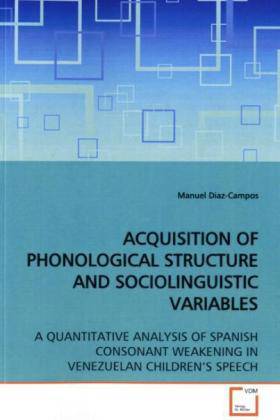
ACQUISITION OF PHONOLOGICAL STRUCTURE AND SOCIOLINGUISTIC VARIABLES
A QUANTITATIVE ANALYSIS OF SPANISH CONSONANT WEAKENING IN VENEZUELAN CHILDREN S SPEECH
Manuel Diaz-Campos
Paperback | Engels
€ 67,45
+ 134 punten
Omschrijving
This book analyzes the acquisition of sounds
that exhibit sociophonological variation in Spanish.
Specifically, this study has analyzed the acquisition
of two variable phonological phenomena in Venezuelan
children s speech: intervocalic /d/ and
syllable-final /-r/.
30 monolingual Spanish-speaking children were
selected from the corpus Competencia Narrativa de
Niños en Edad Escolar (1996). The speakers were
divided into five groups according to age (42-47
months, 48-53 months, 54-59 months, 60-65 months, and
66-77 months); two groups according to socioeconomic
class (16 lower-class and 14 upper-class speakers);
and two groups according to sex (16 male and 14
female speakers).
The findings of this study demonstrate that, from a
very early age, children begin to use variable
phonology with a sociolinguistic value that is
similar to that of the adult model. Children acquire
first the sociolect of their immediate community,
but, with regular exposure to other systems, they
begin not only incorporating new repertoires in their
speech, but also assigning social value to them.
that exhibit sociophonological variation in Spanish.
Specifically, this study has analyzed the acquisition
of two variable phonological phenomena in Venezuelan
children s speech: intervocalic /d/ and
syllable-final /-r/.
30 monolingual Spanish-speaking children were
selected from the corpus Competencia Narrativa de
Niños en Edad Escolar (1996). The speakers were
divided into five groups according to age (42-47
months, 48-53 months, 54-59 months, 60-65 months, and
66-77 months); two groups according to socioeconomic
class (16 lower-class and 14 upper-class speakers);
and two groups according to sex (16 male and 14
female speakers).
The findings of this study demonstrate that, from a
very early age, children begin to use variable
phonology with a sociolinguistic value that is
similar to that of the adult model. Children acquire
first the sociolect of their immediate community,
but, with regular exposure to other systems, they
begin not only incorporating new repertoires in their
speech, but also assigning social value to them.
Specificaties
Betrokkenen
- Auteur(s):
- Uitgeverij:
Inhoud
- Aantal bladzijden:
- 180
- Taal:
- Engels
Eigenschappen
- Productcode (EAN):
- 9783639167825
- Uitvoering:
- Paperback


Alleen bij Standaard Boekhandel
+ 134 punten op je klantenkaart van Standaard Boekhandel
CADEAU


Beoordelingen
We publiceren alleen reviews die voldoen aan de voorwaarden voor reviews. Bekijk onze voorwaarden voor reviews.