


- Afhalen na 1 uur in een winkel met voorraad
- Gratis thuislevering in België vanaf € 30
- Ruim aanbod met 7 miljoen producten
- Afhalen na 1 uur in een winkel met voorraad
- Gratis thuislevering in België vanaf € 30
- Ruim aanbod met 7 miljoen producten





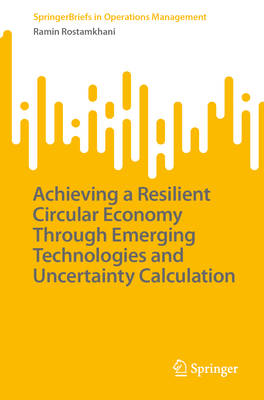
Achieving a Resilient Circular Economy Through Emerging Technologies and Uncertainty Calculation
Ramin Rostamkhani
€ 74,45
+ 148 punten
Omschrijving
This book outlines a practical framework for implementing a resilient circular economy principle across ten major industries in a developed country. It focuses on integrating circular thinking into supply chain management and applying digital transformation, blockchain technologies, and Industry 4.0 and 5.0 tools to improve sustainability and productivity. The book introduces a three-platform model that categorizes supply chain elements, aligns technologies with organizational goals, and supports lean and agile manufacturing practices. It also incorporates quantum economics to address uncertainty in economic modeling--an emerging approach that enhances the reliability of circular economy strategies. Expert evaluations are used to score performance matrices across industries, helping prioritize technologies and assess their impact. The book also applies quality engineering methods such as quality function deployment and value engineering to guide decision-making. Readers will gain a clear understanding of how circular supply chain components contribute to a resilient circular economy goal, how emerging technologies support these efforts, and how uncertainty modeling can improve real-world applications. This book would be a useful read for researchers, policymakers, and industry professionals seeking structured methods to support a large-scale resilient circular economy initiative.
Specificaties
Betrokkenen
- Auteur(s):
- Uitgeverij:
Inhoud
- Aantal bladzijden:
- 85
- Taal:
- Engels
- Reeks:
Eigenschappen
- Productcode (EAN):
- 9789819557042
- Verschijningsdatum:
- 20/06/2026
- Uitvoering:
- Paperback
- Formaat:
- Trade paperback (VS)
- Afmetingen:
- 155 mm x 235 mm


Alleen bij Standaard Boekhandel
+ 148 punten op je klantenkaart van Standaard Boekhandel
Cadeau

AANGERADEN


Beoordelingen
We publiceren alleen reviews die voldoen aan de voorwaarden voor reviews. Bekijk onze voorwaarden voor reviews.