


- Afhalen na 1 uur in een winkel met voorraad
- Gratis thuislevering in België vanaf € 30
- Ruim aanbod met 7 miljoen producten
- Afhalen na 1 uur in een winkel met voorraad
- Gratis thuislevering in België vanaf € 30
- Ruim aanbod met 7 miljoen producten





€ 317,95
+ 635 punten
Omschrijving
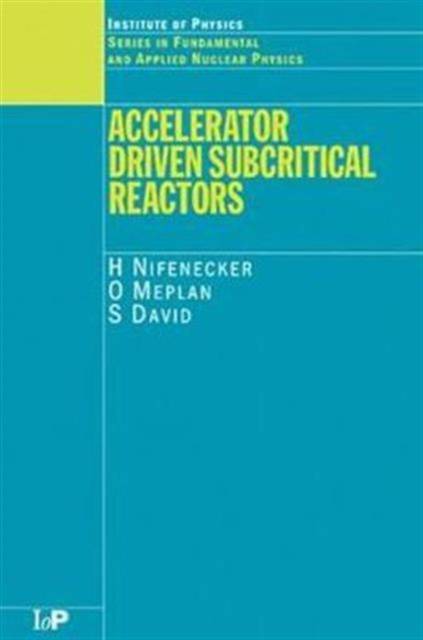
This book describes the basic knowledge in nuclear, neutron, and reactor physics necessary for understanding the principle and implementation of accelerator driven subcritical nuclear reactors (ADSRs), also known as hybrid reactors. Since hybrid reactors may contribute to future nuclear energy production, the book begins with a discussion of the general energy problem. It proceeds by developing the elementary physics of neutron reactors, including the basic nuclear physics involved. The book then presents computational methods, with special emphasis on Monte Carlo methods. It examines the specifics of ADSR, starting from the neutron spallation source to safety features. A thorough discussion is given on the size of hybrid reactors, which follows very different constraints from that of critical reactors. The possibility to optimize the source importance is examined in detail. The discussion of the fuel evolution follows with its relevance to safety and to the waste production and incineration. The conditions for having a constant reactivity over sufficiently long lapse of time are also discussed. The book also evaluates a number of practical designs that have been proposed. Finally, the last chapter deals with the examination of proposed and possible waste transmutation policies and the role which could be played by ADSR in this context. The potential advantage of the Thorium cycle is discussed as well as different scenarios that could be used to implement it.
Specificaties
Betrokkenen
- Auteur(s):
- Uitgeverij:
Inhoud
- Aantal bladzijden:
- 326
- Taal:
- Engels
- Reeks:
Eigenschappen
- Productcode (EAN):
- 9780750307437
- Verschijningsdatum:
- 1/06/2003
- Uitvoering:
- Hardcover
- Formaat:
- Genaaid
- Afmetingen:
- 163 mm x 236 mm
- Gewicht:
- 684 g


Alleen bij Standaard Boekhandel
+ 635 punten op je klantenkaart van Standaard Boekhandel
Cadeau

AANGERADEN


Beoordelingen
We publiceren alleen reviews die voldoen aan de voorwaarden voor reviews. Bekijk onze voorwaarden voor reviews.