


- Afhalen na 1 uur in een winkel met voorraad
- Gratis thuislevering in België vanaf € 30
- Ruim aanbod met 7 miljoen producten
- Afhalen na 1 uur in een winkel met voorraad
- Gratis thuislevering in België vanaf € 30
- Ruim aanbod met 7 miljoen producten





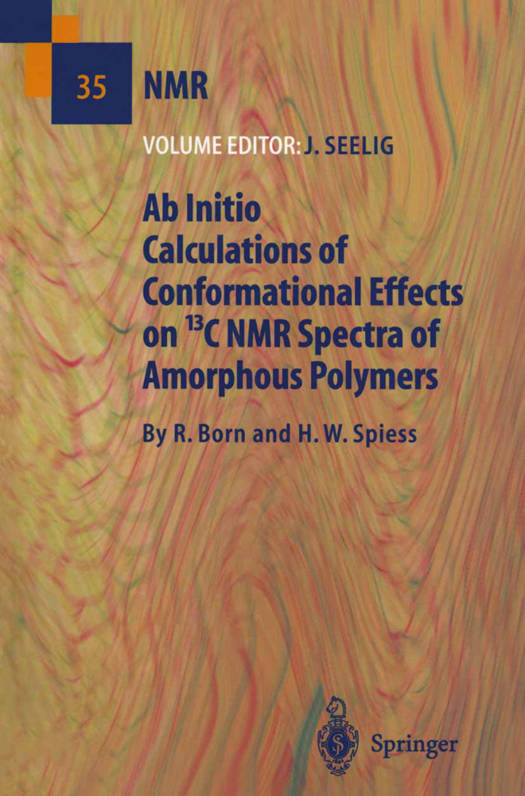
AB Initio Calculations of Conformational Effects on 13c NMR Spectra of Amorphous Polymers
R Born, H W Spiess
€ 195,95
+ 391 punten
Omschrijving
In NMR, it is well-known that the chemical shift conveys structural informa- tion, e. g. a carbonyl carbon will have a resonance frequency appreciably dif- ferent from a methyl carbon, etc. The relation between structure and chemical shift is mostly established by empirical rules on the basis of prior experience. It is only quite recently that the advent of both comparatively cheap comput- ing power and novel quantum chemistry approaches have provided feasible routes to calculate the chemical shift at the ab initio level for molecules of reasonable size. This raises the question whether application of these novel theoretical concepts offers a means of obtaining new structural information for the complex chain molecules one deals with in polymer science. Solid state 13C-NMR spectra of glassy amorphous polymers display broad, partially structured resonance regions that reflect the underlying disorder of the polymer chains. The chemical shift responds to the variation of the ge- ometry of the chain, and the broad resonance regions can be explained by an inhomogeneous superposition of various chain geometries (and thus chem- ical shifts). In this review, we present a novel approach to combine polymer chain statistical models, quantum chemistry and solid state NMR to pro- vide quantitative information about the local chain geometry in amorphous polymers. The statistical model yields the relative occurrence of the various geometries, and quantum chemistry (together with a force field geometry op- timization) establishes the link between geometry and chemical shift.
Specificaties
Betrokkenen
- Auteur(s):
- Uitgeverij:
Inhoud
- Aantal bladzijden:
- 126
- Taal:
- Engels
- Reeks:
- Reeksnummer:
- nr. 35
Eigenschappen
- Productcode (EAN):
- 9783642644900
- Verschijningsdatum:
- 16/09/2011
- Uitvoering:
- Paperback
- Formaat:
- Trade paperback (VS)
- Afmetingen:
- 156 mm x 234 mm
- Gewicht:
- 204 g


Alleen bij Standaard Boekhandel
+ 391 punten op je klantenkaart van Standaard Boekhandel
Wedstrijd


Beoordelingen
We publiceren alleen reviews die voldoen aan de voorwaarden voor reviews. Bekijk onze voorwaarden voor reviews.