



Je cadeautjes zeker op tijd in huis hebben voor de feestdagen? Kom langs in onze winkels en vind het perfecte geschenk!
- Afhalen na 1 uur in een winkel met voorraad
- Gratis thuislevering in België vanaf € 30
- Ruim aanbod met 7 miljoen producten
Je cadeautjes zeker op tijd in huis hebben voor de feestdagen? Kom langs in onze winkels en vind het perfecte geschenk!
- Afhalen na 1 uur in een winkel met voorraad
- Gratis thuislevering in België vanaf € 30
- Ruim aanbod met 7 miljoen producten





€ 34,95
+ 69 punten
Omschrijving
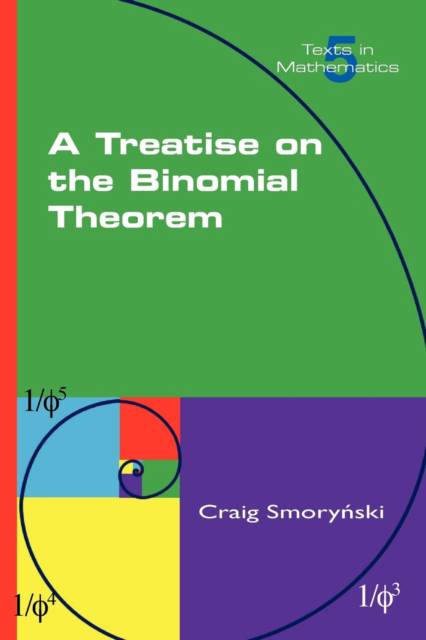
"The binomial theorem is usually quite rightly considered as one of the most important theorems in the whole of analysis." Thus wrote Bernard Bolzano in 1816 in introducing the first correct proof of Newton's generalisation of a century and a half earlier of a result familiar to us all from elementary algebra. Bolzano's appraisal may surprise the modern reader familiar only with the finite algebraic version of the Binomial Theorem involving positive integral exponents, and may also appear incongruous to one familiar with Newton's series for rational exponents. Yet his statement was a sound judgment back in the day. Here the story of the Binomial Theorem is presented in all its glory, from the early days in India, the Moslem world, and China as an essential tool for root extraction, through Newton's generalisation and its central role in infinite series expansions in the 17th and 18th centuries, and to its rigorous foundation in the 19th. The exposition is well-organised and fairly complete with all the necessary details, yet still readable and understandable for those with a limited mathematical background, say at the Calculus level or just below that. The present book, with its many citations from the literature, will be of interest to anyone concerned with the history or foundations of mathematics.
Specificaties
Betrokkenen
- Auteur(s):
- Uitgeverij:
Inhoud
- Aantal bladzijden:
- 358
- Taal:
- Engels
- Reeks:
Eigenschappen
- Productcode (EAN):
- 9781848900851
- Verschijningsdatum:
- 8/10/2012
- Uitvoering:
- Paperback
- Formaat:
- Trade paperback (VS)
- Afmetingen:
- 156 mm x 234 mm
- Gewicht:
- 498 g


Alleen bij Standaard Boekhandel
+ 69 punten op je klantenkaart van Standaard Boekhandel
CADEAU


Beoordelingen
We publiceren alleen reviews die voldoen aan de voorwaarden voor reviews. Bekijk onze voorwaarden voor reviews.