


- Afhalen na 1 uur in een winkel met voorraad
- Gratis thuislevering in België vanaf € 30
- Ruim aanbod met 7 miljoen producten
- Afhalen na 1 uur in een winkel met voorraad
- Gratis thuislevering in België vanaf € 30
- Ruim aanbod met 7 miljoen producten





€ 38,95
+ 77 punten
Omschrijving
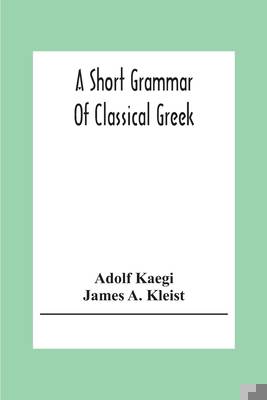
A Short Grammar of Classical Greek distils the essentials of an ancient tongue with quiet precision. A concise guide for beginners. Adolf Kaegi's compact manual reduces complex paradigms to readable rules, presenting Greek syntax and morphology with economy and clarity. At once a concise Greek reference and an academic Greek manual, it balances technical rigour with approachable phrasing, serving as a practical language learning resource and a compact classical studies textbook for both formal teaching and independent ancient Greek language study. Concision is its strength: focused entries and direct exposition let readers consult grammar points between readings of classical authors without losing momentum. It is an ideal concise Greek reference for Greek for beginners while remaining robust enough for more advanced philological work; a compact classical Greek grammar guide that honours precision over clutter. Republished by Alpha Editions in a careful modern edition, this volume preserves the spirit of the original while making it effortless to enjoy today - a heritage title prepared for readers and collectors alike. Rooted in the methodical scholarship of its era and informed by 19th-century linguistics, Kaegi's work functions as both a historical language guide and a plain, serviceable academic Greek manual. Its significance lies in a clear-eyed approach to morphology and syntax that anticipates modern emphasis on structure and usage, offering students a way to understand how classical grammarians reasoned. Useful for teachers as classroom support and for independent learners as steady ancient language instruction, it is also a welcome addition to any Greek grammar collection. Suited equally to casual readers exploring classical texts and to classic-literature collectors assembling thoughtful editions, this edition respects both study and collecting. Beyond utility, it offers a window onto past scholarly practice: its succinct stance reveals how teachers introduced pupils to inflection, syntax and philology. For readers assembling a curated library, the work complements wider studies in classical philology and 19th-century linguistics; it also serves scholars tracing the history of ancient language instruction. Its plain, uncluttered voice rewards repeated consultation and quiet reflection.
Specificaties
Betrokkenen
- Auteur(s):
- Uitgeverij:
Inhoud
- Aantal bladzijden:
- 272
- Taal:
- Engels
Eigenschappen
- Productcode (EAN):
- 9789354304149
- Verschijningsdatum:
- 15/12/2020
- Uitvoering:
- Paperback
- Formaat:
- Trade paperback (VS)
- Afmetingen:
- 152 mm x 229 mm
- Gewicht:
- 403 g


Alleen bij Standaard Boekhandel
+ 77 punten op je klantenkaart van Standaard Boekhandel
CADEAU

AANGERADEN


Beoordelingen
We publiceren alleen reviews die voldoen aan de voorwaarden voor reviews. Bekijk onze voorwaarden voor reviews.