


- Afhalen na 1 uur in een winkel met voorraad
- Gratis thuislevering in België vanaf € 30
- Ruim aanbod met 7 miljoen producten
- Afhalen na 1 uur in een winkel met voorraad
- Gratis thuislevering in België vanaf € 30
- Ruim aanbod met 7 miljoen producten





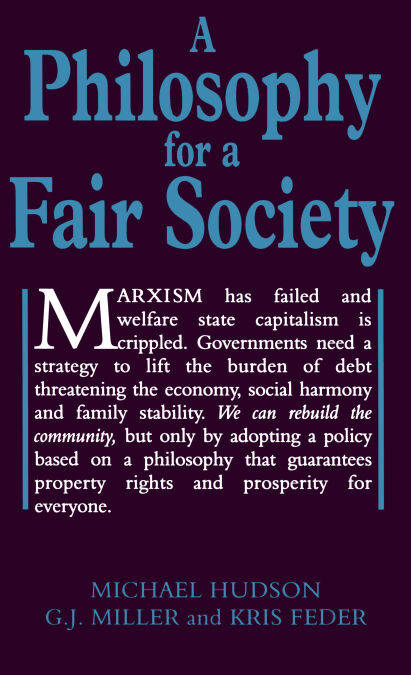
A Philosophy for a Fair Society (Georgist Paradigm series) E-BOOK
Michael Hudson, Kris Feder, G.J. MIller
E-book | Engels
€ 7,99
+ 7 punten
Omschrijving
Something must be done, explain the authors, but governments will fail again unless they shake off the economic orthodoxy which is now one of the problems rather than the means to a solution.
This book investigates the roots of the problem, both historically and theoretically. Dr Michael Hudson draws on archaeology and history, from Bronze-Age Mesopotamia through Rome to Byzantium, to show how a destructive virus crept into the body politic. This led to a breakdown in man's relationship to the environment, and divided society into a wealthy ruling oligarchy and an impoverished majority. The Welfare State seeks to remedy this man-made injustice, but, despite the escalating cost to taxpayers, it has failed to stop the widening gap between rich and poor. Drawing on medical evidence, Dr George Miller demonstrates that not only have the poorest grown poorer relatively, but their health has suffered disproportionately, so that people born into the lowest classes still have a greater chance of dying before they can enjoy their pensions. A century ago, Henry George, in "Progress and Poverty", asked why there was still poverty, when the Industrial Revolution had made it possible to manufacture in a day what had taken weeks or months previously. Dr Kris Feder shows how the Georgist paradigm provides an ideal way of tackling the many ills besetting the industrialized and Third Worlds. It is recommended by three Nobel prize-winning economists as the way forward for Russia. Dr Feder clears away misrepresentations of George's thesis, and explains how it would not only lead to a fairer distribution of wealth, but would also simplify the tax system. Michael Hudson is the author of "Trade, Development and Foreign Debt".
This book investigates the roots of the problem, both historically and theoretically. Dr Michael Hudson draws on archaeology and history, from Bronze-Age Mesopotamia through Rome to Byzantium, to show how a destructive virus crept into the body politic. This led to a breakdown in man's relationship to the environment, and divided society into a wealthy ruling oligarchy and an impoverished majority. The Welfare State seeks to remedy this man-made injustice, but, despite the escalating cost to taxpayers, it has failed to stop the widening gap between rich and poor. Drawing on medical evidence, Dr George Miller demonstrates that not only have the poorest grown poorer relatively, but their health has suffered disproportionately, so that people born into the lowest classes still have a greater chance of dying before they can enjoy their pensions. A century ago, Henry George, in "Progress and Poverty", asked why there was still poverty, when the Industrial Revolution had made it possible to manufacture in a day what had taken weeks or months previously. Dr Kris Feder shows how the Georgist paradigm provides an ideal way of tackling the many ills besetting the industrialized and Third Worlds. It is recommended by three Nobel prize-winning economists as the way forward for Russia. Dr Feder clears away misrepresentations of George's thesis, and explains how it would not only lead to a fairer distribution of wealth, but would also simplify the tax system. Michael Hudson is the author of "Trade, Development and Foreign Debt".
Specificaties
Betrokkenen
- Auteur(s):
- Uitgeverij:
Inhoud
- Aantal bladzijden:
- 398
- Taal:
- Engels
Eigenschappen
- Productcode (EAN):
- 9780856831591
- Verschijningsdatum:
- 7/08/2012
- Uitvoering:
- E-book
- Beveiligd met:
- Digital watermarking
- Formaat:
- ePub


Alleen bij Standaard Boekhandel
+ 7 punten op je klantenkaart van Standaard Boekhandel
Cadeau

AANGERADEN


Beoordelingen
We publiceren alleen reviews die voldoen aan de voorwaarden voor reviews. Bekijk onze voorwaarden voor reviews.