


- Afhalen na 1 uur in een winkel met voorraad
- Gratis thuislevering in België vanaf € 30
- Ruim aanbod met 7 miljoen producten
- Afhalen na 1 uur in een winkel met voorraad
- Gratis thuislevering in België vanaf € 30
- Ruim aanbod met 7 miljoen producten





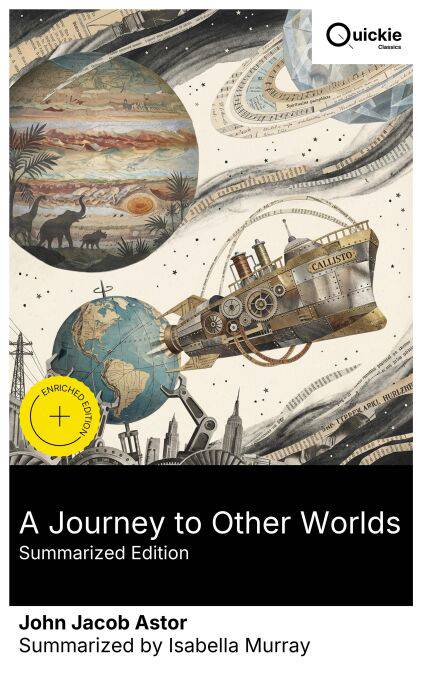
A Journey to Other Worlds (Summarized Edition) E-BOOK
Enriched edition. Interplanetary adventures with antigravity tech, alien wildlife, and spiritual foresight on a futuristic voyage to the year 2000
John Jacob Astor
E-book | Engels
€ 1,99
+ 1 punten
Eenvoudig bestellen
Veilig betalen


Onmiddellijk geleverd via e-mail
Omschrijving
A Journey to Other Worlds, a late–nineteenth-century scientific romance set in the year 2000, imagines a United States governed by technocrats who straighten Earth's axis and harvest boundless energy before launching an apergy-propelled craft, the Callisto, to Jupiter and Saturn. Astor alternates engineering exposition with travelogue: prehistoric megafauna and steamy swamps on Jupiter, crystalline landscapes and disembodied intelligences on Saturn, and meditations on immortality. His ornate, reportorial prose, indebted to Verne and contemporaneous utopian fiction, funnels Gilded Age confidence into a panorama of invention, expansion, and spiritual inquiry. John Jacob Astor IV—Gilded Age magnate, hotel builder, and amateur inventor with several patents—writes from the vantage of capital, infrastructure, and restless ingenuity. His experience organizing vast projects and his fascination with electricity, transportation, and celestial science shape the novel's faith in large-scale engineering and corporate rationality. Equally timely is his engagement with spiritualism and psychical speculation, popular among elites of the 1890s, which inflects the Saturn episodes with metaphysical ambition. Recommended to readers of Verne, Bellamy, and early Wells, this novel rewards anyone interested in the prehistory of spaceflight, techno-utopianism, and American imperial imagination. Approach it both as prophecy and artifact, and you will find its boldness illuminating.
Quickie Classics summarizes timeless works with precision, preserving the author's voice and keeping the prose clear, fast, and readable—distilled, never diluted. Enriched Edition extras: Introduction · Synopsis · Historical Context · Author Biography · Brief Analysis · 4 Reflection Q&As · Editorial Footnotes.
Quickie Classics summarizes timeless works with precision, preserving the author's voice and keeping the prose clear, fast, and readable—distilled, never diluted. Enriched Edition extras: Introduction · Synopsis · Historical Context · Author Biography · Brief Analysis · 4 Reflection Q&As · Editorial Footnotes.
Specificaties
Betrokkenen
- Auteur(s):
- Uitgeverij:
Inhoud
- Aantal bladzijden:
- 135
- Taal:
- Engels
Eigenschappen
- Productcode (EAN):
- 8596547882039
- Verschijningsdatum:
- 9/01/2026
- Uitvoering:
- E-book
- Beveiligd met:
- Digital watermarking
- Formaat:
- ePub


Alleen bij Standaard Boekhandel
+ 1 punten op je klantenkaart van Standaard Boekhandel
CADEAU

AANGERADEN


Beoordelingen
We publiceren alleen reviews die voldoen aan de voorwaarden voor reviews. Bekijk onze voorwaarden voor reviews.