


- Afhalen na 1 uur in een winkel met voorraad
- Gratis thuislevering in België vanaf € 30
- Ruim aanbod met 7 miljoen producten
- Afhalen na 1 uur in een winkel met voorraad
- Gratis thuislevering in België vanaf € 30
- Ruim aanbod met 7 miljoen producten





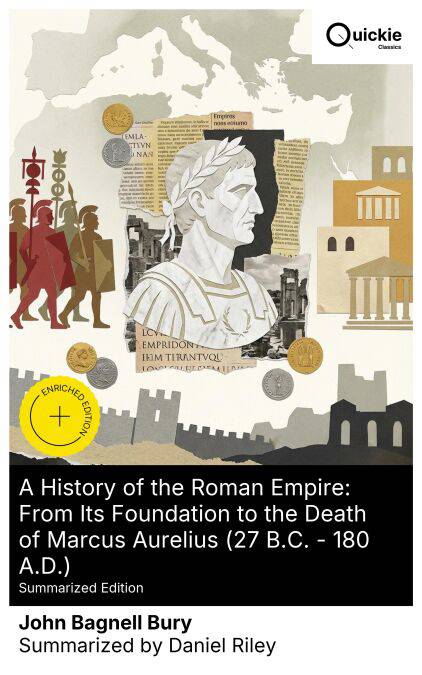
A History of the Roman Empire: From Its Foundation to the Death of Marcus Aurelius (27 B.C. – 180 A.D.) (Summarized Edition) E-BOOK
Enriched edition. Administration, Armies, and Frontiers of the Principate
John Bagnell Bury
E-book | Engels
€ 1,99
+ 1 punten
Eenvoudig bestellen
Veilig betalen


Onmiddellijk geleverd via e-mail
Omschrijving
First published in 1893, John Bagnell Bury's survey of the Principate, from Augustus to Marcus Aurelius, blends panoramic narrative with diagnostic analysis. Chronology is punctuated by thematic chapters on institutions, provincial governance, army and finance, frontier policy, and religious change. Reading Tacitus, Suetonius, and Dio alongside inscriptions and coinage, Bury favors verifiable evidence over rhetoric; the prose is limpid and restrained, a late‑Victorian classic that tempers Gibbon's grand moral arc with Rankean method. An Irish classicist turned Regius Professor of Modern History at Cambridge, Bury (1861–1927) championed history as a science. Training in Greek and Latin philology, editorial work on Gibbon, and close use of epigraphy and numismatics inclined him toward institutional explanation over anecdote, and toward careful source criticism that anchors his portrait of the Julio-Claudian, Flavian, and Antonine regimes. Recommended to students and scholars alike, this remains a lucid, authoritative baseline for the early Empire: rigorous in documentation, alert to administrative mechanics, and immune to melodrama. Read it as a companion to Mommsen and as a corrective to Gibbon's rhetoric, or as a self-sufficient, disciplined guide.
Quickie Classics summarizes timeless works with precision, preserving the author's voice and keeping the prose clear, fast, and readable—distilled, never diluted. Enriched Edition extras: Introduction · Synopsis · Historical Context · Brief Analysis · 4 Reflection Q&As · Editorial Footnotes.
Quickie Classics summarizes timeless works with precision, preserving the author's voice and keeping the prose clear, fast, and readable—distilled, never diluted. Enriched Edition extras: Introduction · Synopsis · Historical Context · Brief Analysis · 4 Reflection Q&As · Editorial Footnotes.
Specificaties
Betrokkenen
- Auteur(s):
- Uitgeverij:
Inhoud
- Aantal bladzijden:
- 208
- Taal:
- Engels
Eigenschappen
- Productcode (EAN):
- 8596547877578
- Verschijningsdatum:
- 9/01/2026
- Uitvoering:
- E-book
- Beveiligd met:
- Digital watermarking
- Formaat:
- ePub


Alleen bij Standaard Boekhandel
+ 1 punten op je klantenkaart van Standaard Boekhandel
CADEAU

AANGERADEN


Beoordelingen
We publiceren alleen reviews die voldoen aan de voorwaarden voor reviews. Bekijk onze voorwaarden voor reviews.