


- Afhalen na 1 uur in een winkel met voorraad
- Gratis thuislevering in België vanaf € 30
- Ruim aanbod met 7 miljoen producten
- Afhalen na 1 uur in een winkel met voorraad
- Gratis thuislevering in België vanaf € 30
- Ruim aanbod met 7 miljoen producten





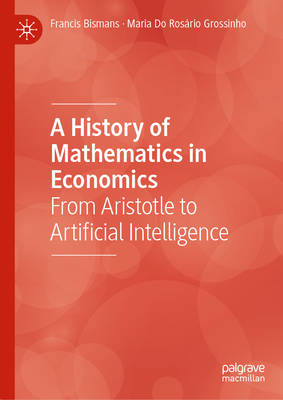
A History of Mathematics in Economics
From Aristotle to Artificial Intelligence
Francis Bismans, Maria Do Rosário Grossinho
Hardcover | Engels
€ 128,45
+ 256 punten
Omschrijving
This book explores the importance of mathematics (analysis, algebra, topology, probability, and inferential statistics) within the history and development of economics. It offers a long-term perspective on the links between mathematics and economics, taking into account the influence of historical events, to create a genealogy of quantitative economics. Starting with Aristotle and the early economic pioneers, such as Petty, Isnard, Cournot, Ricardo, Marx, and Walras, the development of economics over many centuries is charted, including marginalism, general equilibrium, neoclassical synthesis, linear economics, game theory, econometrics, financial theory, and artificial intelligence. This book provides insight into an overlooked part of economics' history to create a new framework for economic analysis. It will be relevant to students and researchers interested in the history of economic thought from a quantitative perspective, filling a gap in the existing literature.
Specificaties
Betrokkenen
- Auteur(s):
- Uitgeverij:
Inhoud
- Aantal bladzijden:
- 392
- Taal:
- Engels
Eigenschappen
- Productcode (EAN):
- 9783032173508
- Verschijningsdatum:
- 16/07/2026
- Uitvoering:
- Hardcover
- Formaat:
- Genaaid
- Afmetingen:
- 148 mm x 210 mm


Alleen bij Standaard Boekhandel
+ 256 punten op je klantenkaart van Standaard Boekhandel
CADEAU

AANGERADEN


Beoordelingen
We publiceren alleen reviews die voldoen aan de voorwaarden voor reviews. Bekijk onze voorwaarden voor reviews.