


- Afhalen na 1 uur in een winkel met voorraad
- Gratis thuislevering in België vanaf € 30
- Ruim aanbod met 7 miljoen producten
- Afhalen na 1 uur in een winkel met voorraad
- Gratis thuislevering in België vanaf € 30
- Ruim aanbod met 7 miljoen producten





€ 35,43
+ 70 punten
Eenvoudig bestellen
Veilig betalen


Gratis thuislevering vanaf € 30 (via bpost)
Gratis levering in je Standaard Boekhandel
Omschrijving
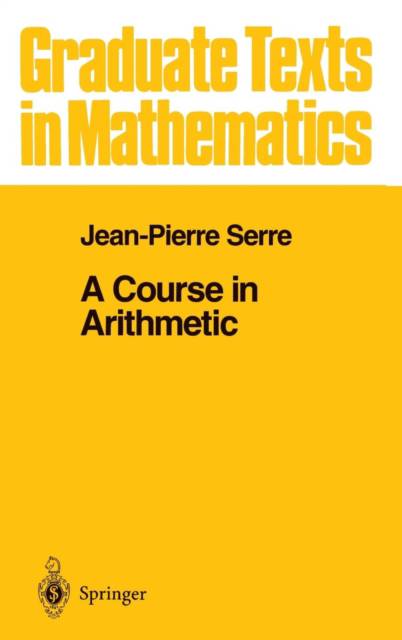
This book is divided into two parts. The first one is purely algebraic. Its objective is the classification of quadratic forms over the field of rational numbers (Hasse-Minkowski theorem). It is achieved in Chapter IV. The first three chapters contain some preliminaries: quadratic reciprocity law, p-adic fields, Hilbert symbols. Chapter V applies the preceding results to integral quadratic forms of discriminant ± I. These forms occur in various questions: modular functions, differential topology, finite groups. The second part (Chapters VI and VII) uses "analytic" methods (holomor- phic functions). Chapter VI gives the proof of the "theorem on arithmetic progressions" due to Dirichlet; this theorem is used at a critical point in the first part (Chapter Ill, no. 2.2). Chapter VII deals with modular forms, and in particular, with theta functions. Some of the quadratic forms of Chapter V reappear here. The two parts correspond to lectures given in 1962 and 1964 to second year students atthe Ecole Normale Superieure. A redaction of these lectures in the form of duplicated notes, was made by J.-J. Sansuc (Chapters I-IV) and J.-P. Ramis and G. Ruget (Chapters VI-VII). They were very useful to me; I extend here my gratitude to their authors.
Specificaties
Betrokkenen
- Auteur(s):
- Uitgeverij:
Inhoud
- Aantal bladzijden:
- 119
- Taal:
- Engels
- Reeks:
- Reeksnummer:
- nr. 7
Eigenschappen
- Productcode (EAN):
- 9780387900407
- Verschijningsdatum:
- 29/11/1978
- Uitvoering:
- Hardcover
- Formaat:
- Genaaid
- Afmetingen:
- 161 mm x 243 mm
- Gewicht:
- 340 g


Alleen bij Standaard Boekhandel
+ 70 punten op je klantenkaart van Standaard Boekhandel
CADEAU

AANGERADEN


Beoordelingen
We publiceren alleen reviews die voldoen aan de voorwaarden voor reviews. Bekijk onze voorwaarden voor reviews.