


- Afhalen na 1 uur in een winkel met voorraad
- Gratis thuislevering in België vanaf € 30
- Ruim aanbod met 7 miljoen producten
- Afhalen na 1 uur in een winkel met voorraad
- Gratis thuislevering in België vanaf € 30
- Ruim aanbod met 7 miljoen producten





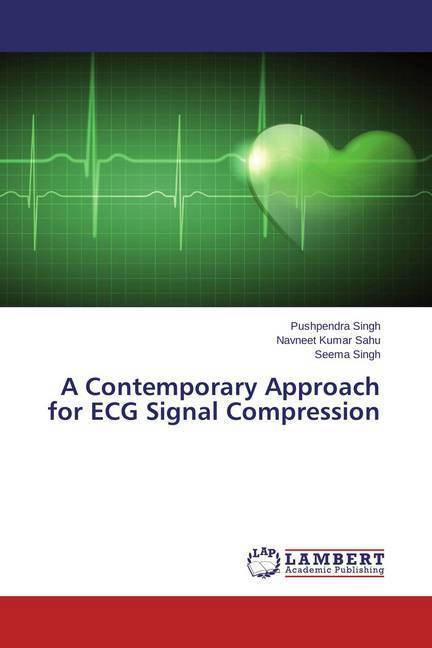
A Contemporary Approach for ECG Signal Compression
Pushpendra Singh, Navneet Kumar Sahu, Seema Singh
Paperback | Engels
€ 54,45
+ 108 punten
Omschrijving
Most of the signals in practice are time-domain signals in their raw format. Time amplitude representation is not always the best representation of the signal for most signal processing related applications. Fourier analysis has a serious drawback that in transforming to the frequency domain, time information is lost. This drawback isn't very important if the signal is a stationary signal. However, most interesting signals are non-stationary (ECG, EMG, EEG etc.) and thus Fourier analysis is not suited to detecting transitory characteristics. The traditional Fourier transform only provides the spectral information of a signal and thus it is not suitable for the analysis of non-stationary signals and hence a more suitable technique has been applied for the study. The main goal of the book is to develop the compression algorithms based upon the various one transform techniques available and from there to develop a new two dimensional Transform technique which will give better results as compared to the previous one dimensional signal compression technique without loss of any signal information.
Specificaties
Betrokkenen
- Auteur(s):
- Uitgeverij:
Inhoud
- Aantal bladzijden:
- 96
- Taal:
- Engels
Eigenschappen
- Productcode (EAN):
- 9783659692499
- Verschijningsdatum:
- 8/04/2015
- Uitvoering:
- Paperback
- Afmetingen:
- 150 mm x 220 mm
- Gewicht:
- 144 g


Alleen bij Standaard Boekhandel
+ 108 punten op je klantenkaart van Standaard Boekhandel
Cadeau

AANGERADEN


Beoordelingen
We publiceren alleen reviews die voldoen aan de voorwaarden voor reviews. Bekijk onze voorwaarden voor reviews.