


- Afhalen na 1 uur in een winkel met voorraad
- Gratis thuislevering in België vanaf € 30
- Ruim aanbod met 7 miljoen producten
- Afhalen na 1 uur in een winkel met voorraad
- Gratis thuislevering in België vanaf € 30
- Ruim aanbod met 7 miljoen producten





€ 17,45
+ 34 punten
Omschrijving
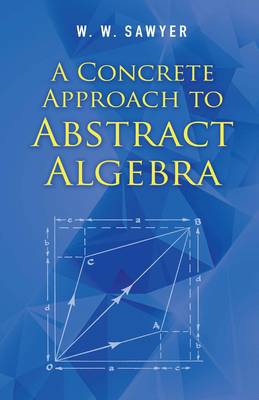
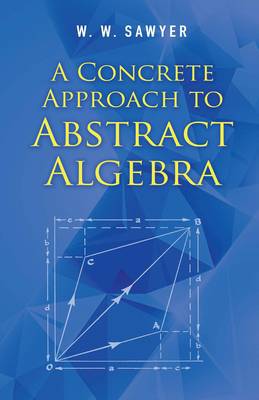
Brief, clear, and well written, this introduction to abstract algebra bridges the gap between the solid ground of traditional algebra and the abstract territory of modern algebra. The only prerequisite is high school-level algebra.
Author W. W. Sawyer begins with a very basic viewpoint of abstract algebra, using simple arithmetic and elementary algebra. He then proceeds to arithmetic and polynomials, slowly progressing to more complex matters: finite arithmetic, an analogy between integers and polynomials, an application of the analogy, extending fields, and linear dependence and vector spaces. Additional topics include algebraic calculations with vectors, vectors over a field, and fields regarded as vector spaces. The final chapter proves that angles cannot be trisected by Euclidean means, using a proof that shows how modern algebraic concepts can be used to solve an ancient problem. Exercises appear throughout the book, with complete solutions at the end.
Author W. W. Sawyer begins with a very basic viewpoint of abstract algebra, using simple arithmetic and elementary algebra. He then proceeds to arithmetic and polynomials, slowly progressing to more complex matters: finite arithmetic, an analogy between integers and polynomials, an application of the analogy, extending fields, and linear dependence and vector spaces. Additional topics include algebraic calculations with vectors, vectors over a field, and fields regarded as vector spaces. The final chapter proves that angles cannot be trisected by Euclidean means, using a proof that shows how modern algebraic concepts can be used to solve an ancient problem. Exercises appear throughout the book, with complete solutions at the end.
Specificaties
Betrokkenen
- Auteur(s):
- Uitgeverij:
Inhoud
- Aantal bladzijden:
- 240
- Taal:
- Engels
- Reeks:
Eigenschappen
- Productcode (EAN):
- 9780486824611
- Verschijningsdatum:
- 15/08/2018
- Uitvoering:
- Paperback
- Formaat:
- Trade paperback (VS)
- Afmetingen:
- 140 mm x 213 mm
- Gewicht:
- 276 g


Alleen bij Standaard Boekhandel
+ 34 punten op je klantenkaart van Standaard Boekhandel
CADEAU


Beoordelingen
We publiceren alleen reviews die voldoen aan de voorwaarden voor reviews. Bekijk onze voorwaarden voor reviews.