


- Afhalen na 1 uur in een winkel met voorraad
- Gratis thuislevering in België vanaf € 30
- Ruim aanbod met 7 miljoen producten
- Afhalen na 1 uur in een winkel met voorraad
- Gratis thuislevering in België vanaf € 30
- Ruim aanbod met 7 miljoen producten





Omschrijving
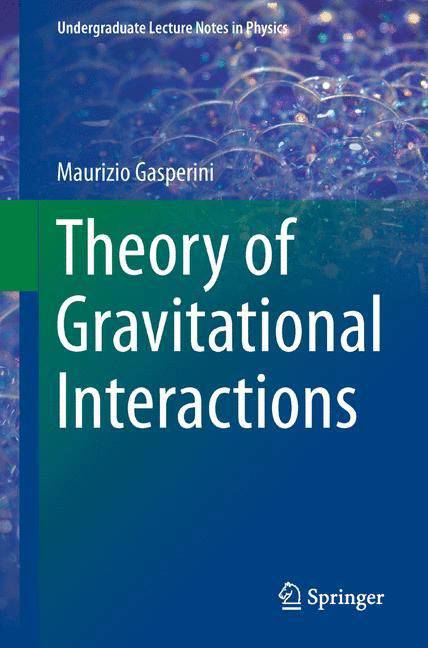
This reference textbook is an up-to-date and self-contained introduction to the theory of gravitational interactions. The first part of the book follows the traditional presentation of general relativity as a geometric theory of the macroscopic gravitational field. A second, advanced part then discusses the deep analogies (and differences) between a geometric theory of gravity and the gauge theories of the other fundamental interactions. This fills a gap which is present in the context of the traditional approach to general relativity, and which usually makes students puzzled about the role of gravity. The necessary notions of differential geometry are reduced to the minimum, leaving more room for those aspects of gravitational physics of current phenomenological and theoretical interest, such as the properties of gravitational waves, the gravitational interactions of spinors, and the supersymmetric generalization of the Einstein equations.
Theory of Gravitational Interactions will be of particular value to undergraduate students pursuing a theoretical or astroparticle curriculum. It can also be used by those teaching related subjects, by PhD students and young researchers working in different scientific sectors but wishing to enlarge their spectrum of interests, and, in general, by all scholars interested in the modern aspects and problems of gravitational interaction.
Theory of Gravitational Interactions will be of particular value to undergraduate students pursuing a theoretical or astroparticle curriculum. It can also be used by those teaching related subjects, by PhD students and young researchers working in different scientific sectors but wishing to enlarge their spectrum of interests, and, in general, by all scholars interested in the modern aspects and problems of gravitational interaction.
Specificaties
Betrokkenen
- Auteur(s):
- Uitgeverij:
Inhoud
- Taal:
- Engels
- Reeks:
- Reeksnummer:
- nr. 23
Eigenschappen
- Productcode (EAN):
- 9788847026902
- Nieuwere uitgave:
- Uitvoering:
- Paperback
- Afmetingen:
- 174 mm x 235 mm


Alleen bij Standaard Boekhandel
+ 128 punten op je klantenkaart van Standaard Boekhandel

Beoordelingen
We publiceren alleen reviews die voldoen aan de voorwaarden voor reviews. Bekijk onze voorwaarden voor reviews.