


- Afhalen na 1 uur in een winkel met voorraad
- Gratis thuislevering in België vanaf € 30
- Ruim aanbod met 7 miljoen producten
- Afhalen na 1 uur in een winkel met voorraad
- Gratis thuislevering in België vanaf € 30
- Ruim aanbod met 7 miljoen producten





Omschrijving
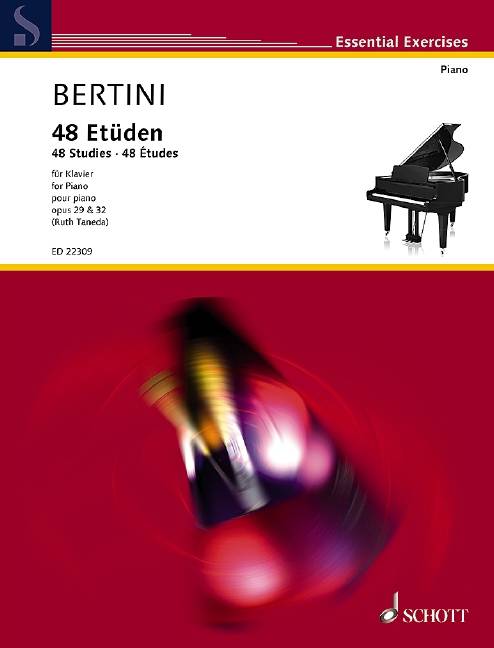
The Etudes op. 29 and op. 32 are among Bertini’s best-known and most influential tutorial works. For aspiring pianists there is much to discover: Pieces with interesting harmonies in keys with up to four sharps or flats display various musical characteristics using a range of different rhythms, articulation and dynamics. With teaching notes by editor Ruth Taneda.
When Henri Jerôme Bertini, born in 1798 in Lyon, developed into a child prodigy who at the age of twelve was already performing in concerts in Paris and other major cities. Concert tours to the Netherlands and Rhineland region followed. After spending some time in England and Scotland, in 1821 he settled in Paris, where besides teaching piano he performed as a pianist at Parisian salons and went on extended concert tours of the provinces in the summer months. Bertini’s teaching activities through to 1848 inspired his ‘Méthode de Piano’ and a wealth of Etudes (op. 29 and 32, op. 66, op. 100 as well as a Nouvelle Collection d’Études in ten volumes varying in degrees of difficulty).
In about 1848 Bertini stopped working as a pianist, composer and teacher, left Paris and retired to the Dauphiné in southeastern France. He died in Meylan near Grenoble on 30 September 1876.
Instrumentation:
piano
op. 29 und op. 32
When Henri Jerôme Bertini, born in 1798 in Lyon, developed into a child prodigy who at the age of twelve was already performing in concerts in Paris and other major cities. Concert tours to the Netherlands and Rhineland region followed. After spending some time in England and Scotland, in 1821 he settled in Paris, where besides teaching piano he performed as a pianist at Parisian salons and went on extended concert tours of the provinces in the summer months. Bertini’s teaching activities through to 1848 inspired his ‘Méthode de Piano’ and a wealth of Etudes (op. 29 and 32, op. 66, op. 100 as well as a Nouvelle Collection d’Études in ten volumes varying in degrees of difficulty).
In about 1848 Bertini stopped working as a pianist, composer and teacher, left Paris and retired to the Dauphiné in southeastern France. He died in Meylan near Grenoble on 30 September 1876.
Instrumentation:
piano
op. 29 und op. 32
Specificaties
Betrokkenen
- Uitgeverij:
Inhoud
- Aantal bladzijden:
- 120
- Reeks:
Eigenschappen
- Productcode (EAN):
- 9790001163651
- Verschijningsdatum:
- 19/09/2018
- Afmetingen:
- 231 mm x 303 mm
- Gewicht:
- 459 g

Alleen bij Standaard Boekhandel
+ 51 punten op je klantenkaart van Standaard Boekhandel
Cadeau

AANGERADEN


Beoordelingen
We publiceren alleen reviews die voldoen aan de voorwaarden voor reviews. Bekijk onze voorwaarden voor reviews.