


- Afhalen na 1 uur in een winkel met voorraad
- Gratis thuislevering in België vanaf € 30
- Ruim aanbod met 7 miljoen producten
- Afhalen na 1 uur in een winkel met voorraad
- Gratis thuislevering in België vanaf € 30
- Ruim aanbod met 7 miljoen producten





Omschrijving
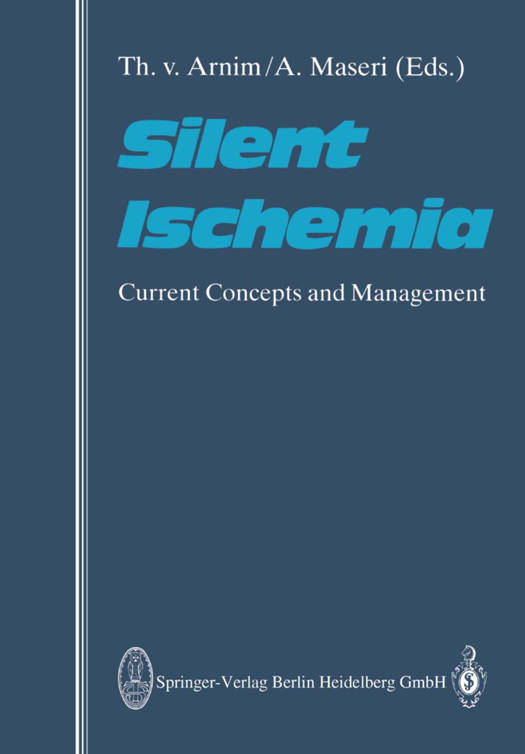
"Silent Ischemia, Current Concepts and Management" contains the proceedings of a conference held in Rottach-Egern, West Germany, March 5 to 7, 1987. We are most grateful to the authors for the effort to provide manuscripts before the meeting, to the sponsor, Bayer AG, for their generous support and to the publishers for their efficient collaboration, all of which have made the appearance of this book possible. When discussing silent myocardial ischemia, the first question is: "why is it silent?". To approach this question, a deeper look has to be taken into the pathophysiology of cardiac pain and the excitatory and inhibitory mechanisms involved. It has to be borne in mind that - in contradiction to what the poets have told us so beautifully for many centuries - the heart is a visceral and not a sensitive organ. If asymptomatic ischemia did not carry prognostic significance comparable to the symp- tomatic manifestations of ischemia, then the problem of silent ischemia would be very academic and without consequences for treatment. Therefore studies on prognosis of silent ischemia are of great importance, as their results should indicate how aggressively patients are to be managed.
Specificaties
Betrokkenen
- Uitgeverij:
Inhoud
- Aantal bladzijden:
- 213
- Taal:
- Engels
Eigenschappen
- Productcode (EAN):
- 9783662129999
- Verschijningsdatum:
- 3/10/2013
- Uitvoering:
- Paperback
- Formaat:
- Trade paperback (VS)
- Afmetingen:
- 170 mm x 244 mm
- Gewicht:
- 362 g

Alleen bij Standaard Boekhandel
+ 307 punten op je klantenkaart van Standaard Boekhandel
CADEAU


Beoordelingen
We publiceren alleen reviews die voldoen aan de voorwaarden voor reviews. Bekijk onze voorwaarden voor reviews.