


- Afhalen na 1 uur in een winkel met voorraad
- Gratis thuislevering in België vanaf € 30
- Ruim aanbod met 7 miljoen producten
- Afhalen na 1 uur in een winkel met voorraad
- Gratis thuislevering in België vanaf € 30
- Ruim aanbod met 7 miljoen producten





€ 152,95
+ 305 punten
Omschrijving
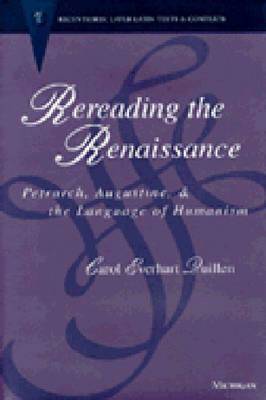
Although Francesco Petrarca's position as the "father" of Italian Renaissance humanism has long been acknowledged, the specific meanings of his works and his legacy remain matters of controversy. Basic questions about the tension between his devotion to secular pursuits and his respect for religious withdrawal, about the authenticity of his ostensibly autobiographical writings, and about his relationship to scholasticism still provoke sustained debate. Rereading the Renaissance, a study of Petrarch's uses of Augustine, uses methods drawn from history and literary criticism to establish a framework for exploring Petrarch's humanism by approaching it through it central practices of reading and writing.
Carol Quillen argues that the essential role of Augustine's words and authority in the expression of Petrarch's humanism is best grasped through a study of the complex textual practices exemplified in the writings of both men. Petrarch's reliance on Augustine is most evident in his ways of reading and in his strategies of argument. Secondly, she maintains that Petrarch's appropriation of Augustine's words is only intelligible in light of his struggle to legitimate his cultural ideals in the face of compelling opposition. Finally, Quillen shows how Petrarch's uses of Augustine can simultaneously uphold his humanist ideals and challenge the legitimacy of the assumptions on which those ideals were founded.
Interdisciplinary in scope and method, this volume speaks to important debates that span the humanities. Scholars of literary and historical studies, as well as those in the fields of classical studies, patristics, and comparative literature, will find in Rereading the Renaissance a solid contribution to their interests.
Carol Everhart Quillen is Associate Professor of History, Rice University.
Carol Quillen argues that the essential role of Augustine's words and authority in the expression of Petrarch's humanism is best grasped through a study of the complex textual practices exemplified in the writings of both men. Petrarch's reliance on Augustine is most evident in his ways of reading and in his strategies of argument. Secondly, she maintains that Petrarch's appropriation of Augustine's words is only intelligible in light of his struggle to legitimate his cultural ideals in the face of compelling opposition. Finally, Quillen shows how Petrarch's uses of Augustine can simultaneously uphold his humanist ideals and challenge the legitimacy of the assumptions on which those ideals were founded.
Interdisciplinary in scope and method, this volume speaks to important debates that span the humanities. Scholars of literary and historical studies, as well as those in the fields of classical studies, patristics, and comparative literature, will find in Rereading the Renaissance a solid contribution to their interests.
Carol Everhart Quillen is Associate Professor of History, Rice University.
Specificaties
Betrokkenen
- Auteur(s):
- Uitgeverij:
Inhoud
- Aantal bladzijden:
- 264
- Taal:
- Engels
- Reeks:
Eigenschappen
- Productcode (EAN):
- 9780472107353
- Verschijningsdatum:
- 16/09/1998
- Uitvoering:
- Hardcover
- Formaat:
- Genaaid
- Afmetingen:
- 152 mm x 235 mm
- Gewicht:
- 512 g


Alleen bij Standaard Boekhandel
+ 305 punten op je klantenkaart van Standaard Boekhandel
CADEAU


Beoordelingen
We publiceren alleen reviews die voldoen aan de voorwaarden voor reviews. Bekijk onze voorwaarden voor reviews.