


- Afhalen na 1 uur in een winkel met voorraad
- Gratis thuislevering in België vanaf € 30
- Ruim aanbod met 7 miljoen producten
- Afhalen na 1 uur in een winkel met voorraad
- Gratis thuislevering in België vanaf € 30
- Ruim aanbod met 7 miljoen producten





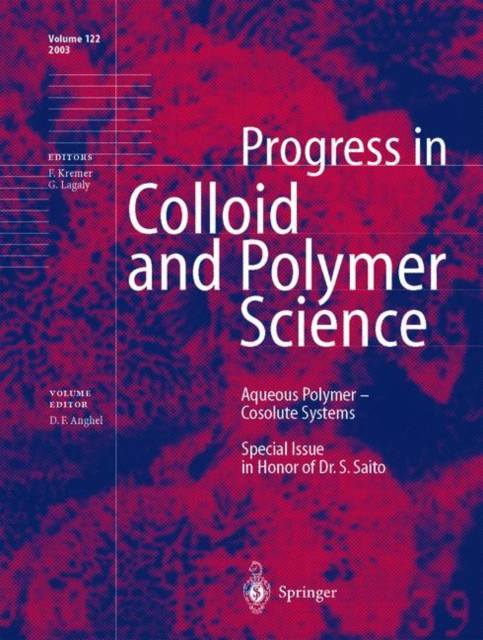
Aqueous Polymer -- Cosolute Systems
Special Issue in Honor of Dr. Shuji Saito
€ 237,59
+ 475 punten
Omschrijving
Springer-Verlag 2003 This issue is dedicated to Doctor Shuji Saito on the occasion of the 50th anniversary of his ?rst paper published in the Journal of German Colloid Society. The paper entitled ''Die Solubilisation von Polyvinylazetat'' by N. Sata and S. Saito appeared in the Kolloid Zeitschrift (1952) 128: 154. According to the title, the paper dealt with the solubilization of poly(vinyl acetate) (PVAc) in aqueous sodium dodecyl sulfate (SDS) solutions. The authors observed that PVAc, a water-insoluble polymer, is c- pletely dissolved by micellar SDS solutions, a result that mostly intrigued them. One has to recall that at that time, the micellar solubilization was the only available theory to explain the dissolution of hydrophobic compounds in micellar systems. The theory worked well in the case of low molecular weight compounds like hydrocarbons, oleophilic dyes, etc., which are solubilized in the inner core of the micelle, but how can a small micelle accommodate a giant polymer molecule? To solve this problem Sata and Saito originally proposed a model consisting of surfactant aggregates formed along the polymer backbone. The model based on simple viscometric measurements was later in the eighties con?rmed by the advent of the more sophisticated neutron scattering technique and is nowadays called the ''necklace model''. During his career, Dr.
Specificaties
Betrokkenen
- Uitgeverij:
Inhoud
- Aantal bladzijden:
- 158
- Taal:
- Engels
- Reeks:
- Reeksnummer:
- nr. 122
Eigenschappen
- Productcode (EAN):
- 9783642055126
- Verschijningsdatum:
- 9/12/2010
- Uitvoering:
- Paperback
- Formaat:
- Trade paperback (VS)
- Afmetingen:
- 210 mm x 279 mm
- Gewicht:
- 399 g

Alleen bij Standaard Boekhandel
+ 475 punten op je klantenkaart van Standaard Boekhandel
CADEAU


Beoordelingen
We publiceren alleen reviews die voldoen aan de voorwaarden voor reviews. Bekijk onze voorwaarden voor reviews.